Fighting for Status: Hierarchy and Conflict in World Politics by Jonathan Renshon
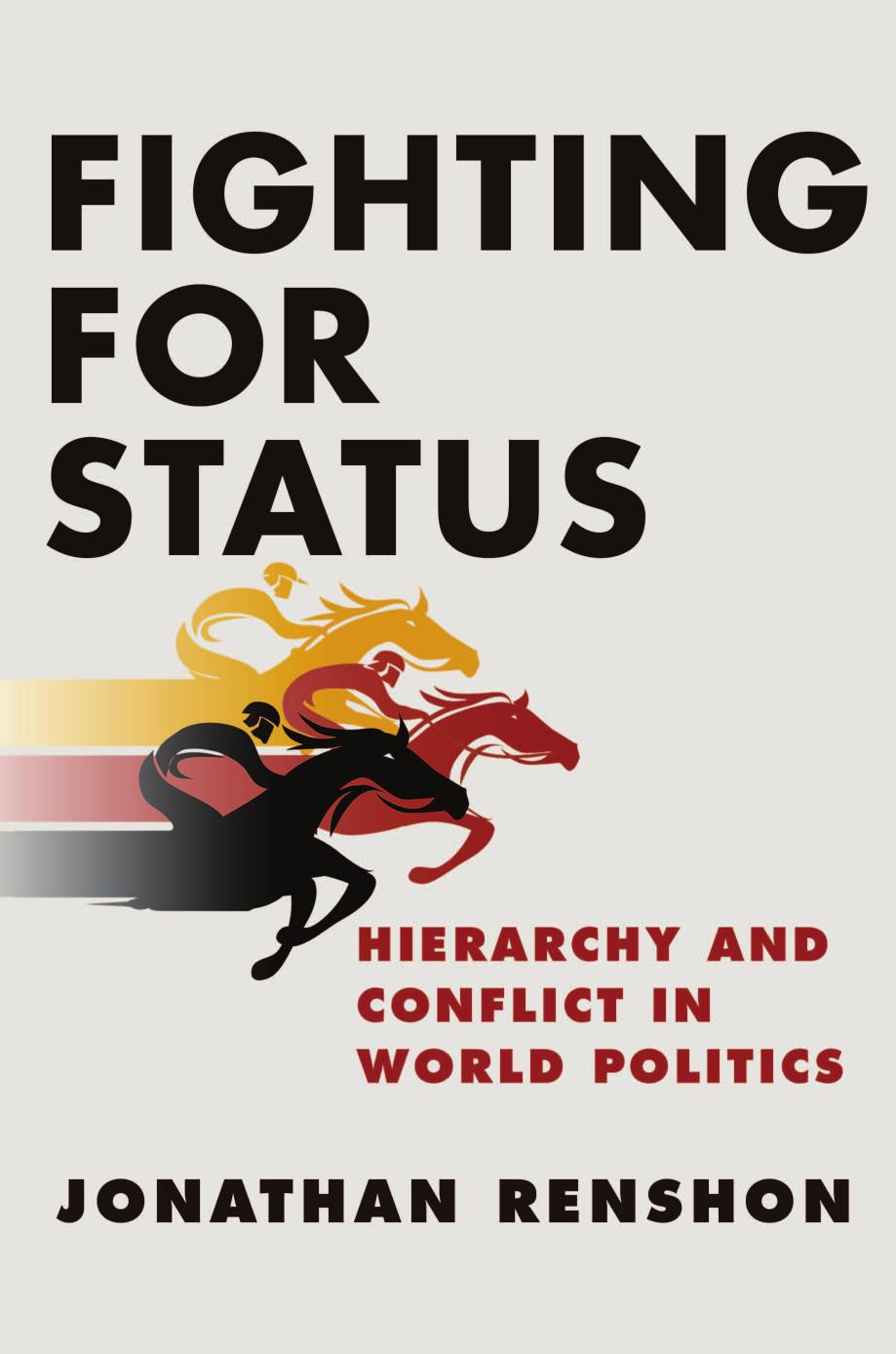
Author:Jonathan Renshon [Renshon, Jonathan]
Language: eng
Format: epub, pdf
ISBN: 9780691174495
Publisher: Princeton University Press
Published: 2017-01-15T07:00:00+00:00
Status Deficit → War → Increased Status
Once those concerns are generated, how do states react? By far the most popular and well-known research on this question is status inconsistency, which argues that leaders will “evidence a strong desire to change the status quo, and failing to do so, to engage in conflict and violence.”6 In this formulation, states that are dissatisfied resort to violence only after failing to change the status quo—that is, out of frustration. This is a rather weak mechanism for linking status and war, however, since it presupposes an irrationality (acting out of frustration rather than strategic interests) that obscures a more likely way in which status concerns might relate to conflict. Because states can expect to profit from higher status, and because status is positional (and thus other states can be expected to be reluctant to cede status voluntarily), violence and conflict may be one way of achieving higher status rather than a last resort after having failed to do so.
Why would violence bring higher status? To answer this, we must first consider how actors develop beliefs about relative standing in a hierarchy. Broadly, beliefs about where each actor stands in a hierarchy are formed via observation of interactions between a group’s members. Some attributes of status (for example, strength or wealth) are visible and thus easily accounted for, while in other cases there are unobservable elements, such as “toughness,” “influence,” or “quality,” that must be inferred through patterns of deference and dominance behavior.
Still, not just any interaction will do if the goal is to shift your position in a hierarchy. Because status is a perceptual construct, cognitive limitations affect the ease with which we can move up or down in a hierarchy. Chief among these restrictions is that beliefs are updated sporadically—not continuously—and then only in response to large events. And since beliefs about status require some consensus in the international community, events are not likely to change a state’s position unless they are highly public (i.e., visible to all actors in the community), dramatic, or salient (in order to capture the attention of potential observers), and convey unambiguous information. Status requires a shared consensus on a given state’s “standing” in the relevant community. Thus, for an event to change status beliefs, it must change all (or the vast majority) of observers’ beliefs in the same way.
Taking these conditions into account, one likely candidate—though not the only possibility—for an event that is capable of changing a state’s place in a status hierarchy is a military conflict. Rationalist scholars have argued that war reveals private information on relative strength otherwise unavailable to potential belligerents. I propose a variant on this: while war (or militarized disputes in which force is used) does reveal private information about capabilities, it reveals other things as well. The capabilities along with behavior of the two opponents and the outcomes observed by the international audience combine to influence the status beliefs of others in the hierarchy. Militarized conflicts—which are public, dramatic, and
Download
Fighting for Status: Hierarchy and Conflict in World Politics by Jonathan Renshon.pdf
This site does not store any files on its server. We only index and link to content provided by other sites. Please contact the content providers to delete copyright contents if any and email us, we'll remove relevant links or contents immediately.
| Arms Control | Diplomacy |
| Security | Trades & Tariffs |
| Treaties | African |
| Asian | Australian & Oceanian |
| Canadian | Caribbean & Latin American |
| European | Middle Eastern |
| Russian & Former Soviet Union |
The Secret History by Donna Tartt(18994)
The Social Justice Warrior Handbook by Lisa De Pasquale(12175)
Thirteen Reasons Why by Jay Asher(8871)
This Is How You Lose Her by Junot Diaz(6854)
Weapons of Math Destruction by Cathy O'Neil(6245)
Zero to One by Peter Thiel(5760)
Beartown by Fredrik Backman(5706)
The Myth of the Strong Leader by Archie Brown(5479)
The Fire Next Time by James Baldwin(5408)
How Democracies Die by Steven Levitsky & Daniel Ziblatt(5198)
Promise Me, Dad by Joe Biden(5127)
Stone's Rules by Roger Stone(5065)
A Higher Loyalty: Truth, Lies, and Leadership by James Comey(4937)
100 Deadly Skills by Clint Emerson(4898)
Rise and Kill First by Ronen Bergman(4757)
Secrecy World by Jake Bernstein(4724)
The David Icke Guide to the Global Conspiracy (and how to end it) by David Icke(4680)
The Farm by Tom Rob Smith(4484)
The Doomsday Machine by Daniel Ellsberg(4472)
